Ritual Lab
Your shelf, read back to you one honest layer at a time
Your skincare shelf, audited.
Tell The Ritual Lab what you already own. It shows how those actives get on, where each one belongs in the day, and the single step worth adding — if there is one at all.
The short answer
The Ritual Lab is a subtraction tool. It checks every pair of actives on your shelf against a fixed set of layering rules, tells you what to keep, move, alternate or drop, builds a morning and evening order, scores the result out of 100 with every deduction shown, and names at most one genuinely missing step.
Built and maintained by the Lumen Ritual editorial team · Last updated:
Independently researched and reviewed for accuracy. Read our editorial policy or how we research routines.
This page contains affiliate links. As an Amazon Associate I earn from qualifying purchases.
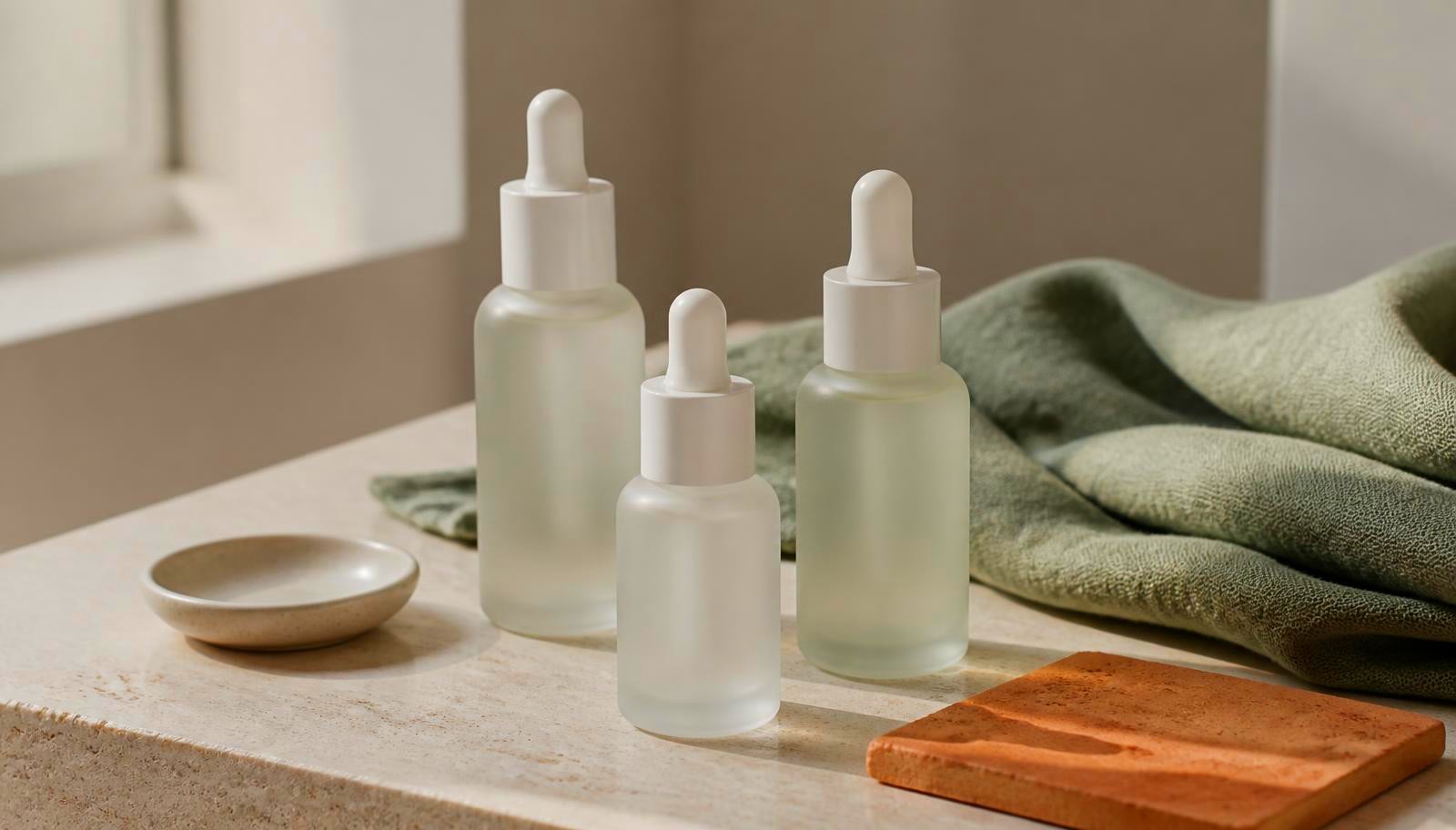
The Ritual Lab reads the bottles you already own. You tell it your skin, climate, and life stage. It keeps, moves, or drops what clashes — vitamin C in the morning, retinoid at night, acids on their own night — then names at most one gap. You leave with a morning and evening ritual, a private cabinet card, and printables you can tape up. Free. No account.
A Lumen Ritual workspace · built with Grok
Open The Ritual LabBack to Lumen Ritual — the guides, reviews and free Quiz are all still here.
Four words do all the work
Every product you enter comes back with one of these, and one sentence saying why. The point of the audit is to simplify the shelf you already own — not to fill it.
- Keep
- The product earns its slot as it is. Nothing to change beyond where it sits in the order.
- Move
- The formula is fine, the timing is not — a vitamin C that belongs in the morning, a retinoid that belongs at night, or two actives that need alternate evenings.
- Drop
- The product duplicates something you already have, or clashes with a stronger active that is doing the same job better.
- One gap
- At most one purchase is ever suggested, and only when an essential step — usually sunscreen or a moisturizer — is genuinely absent.
Why The Ritual Lab subtracts before it adds
Almost every shelf we are shown has the same shape: four or five actives bought one at a time to solve one problem each, no sunscreen, and a moisturizer that ran out months ago. Nothing on that shelf is a bad product. The trouble is that strong ingredients compete for the same skin, and the barrier pays for the overlap long before any of them get a fair run.
So The Ritual Lab starts with what you own rather than with what you could buy. It looks for pairs that need spacing, for actives that would do better on alternate nights, and for the one essential step that is genuinely absent. Most of the time the answer is not another serum — it is moving a retinoid to the evening, or finally replacing the sunscreen. That is a less profitable answer, which is exactly why it is worth giving you.
How the shelf audit works
01
Tell it about you
Life stage, skin type, the one or two things you want to work on, and the climate the routine has to survive. Pregnancy, teen and men apply real filters, not a warning banner.
02
Add your shelf
The categories you own, the actives inside them, and optionally the actual bottles by name. Leave anything out that you are unsure about — The Ritual Lab would rather work with less than guess.
03
See every pair judged
For each pair of actives on your shelf: safe together, space them apart, split morning and evening, alternate nights, or never pair. Each verdict names the rule that produced it.
04
Get a keep, move or drop
Every product gets one decision and one sentence of reasoning, then the survivors are laid out as a numbered morning and evening order, thin to thick.
05
See the one real gap
A compatibility score out of 100 with every deduction itemized, printable cards for the mirror, and at most one product suggested — only when a step is genuinely missing.

How to read the score
The number is a summary of the rules on this page and nothing more. It cannot see your skin, and a lower score does not mean you have done something wrong — a shelf built around one stubborn concern will always look busier than a minimal one. What matters is the list of reasons underneath it: each deduction names what caused it and how many points it cost, so you can fix the specific thing rather than chase the total.
Missing sunscreen is always the heaviest deduction, because it is the only step that protects the work everything else is doing. After that come clashes that need real separation, then pairs that simply want a few minutes between them. If you want the underlying chemistry rather than the verdict, the ingredient pairing guides walk through each combination, and the step-order checker settles what goes on first within a single sitting.
When The Ritual Lab is the wrong tool
If your skin is currently stinging, flaking or tight, no scheduling fixes that. Pause the actives, spend two quiet weeks on barrier repair, then come back and rebuild from one active. And if you are being treated for acne, rosacea or melasma, your prescriber's instructions outrank anything a general tool can work out from a list of categories.
Two shelves, two different answers
The same five bottles do not produce the same plan. These are anonymized examples of what comes back — no brand names, because the reasoning is about the actives, not the labels.
Example one
Oily, breakout-prone, humid climate
Shelf: foaming cleanser, salicylic acid, benzoyl peroxide, retinoid, no sunscreen, no moisturizer.
- Salicylic acid moves to the morning; the retinoid keeps the evening alone.
- Benzoyl peroxide and the retinoid go on alternate nights rather than the same one.
- The foaming cleanser drops to once a day, at night.
- The one gap: a sunscreen. Not a fourth active — the missing step outweighs anything you could add to the three you already have.
Example two
Dry, sensitive, dry-air winter
Shelf: micellar water, vitamin C, glycolic acid, retinol, light gel moisturizer, sunscreen.
- Vitamin C stays in the morning, ahead of the sunscreen.
- Glycolic acid and retinol never share a night; the acid drops to twice a week.
- The gel moisturizer is kept but flagged as too light for the climate and the actives above it.
- The one gap: a richer barrier cream. The shelf has plenty of activity and not enough repair.
Who this is built by, and who pays for it
The Ritual Lab is a Lumen Ritual workspace built with Grok. AI supports the workspace, while Lumen Ritual sets the fixed rules, safety boundaries, product-selection logic and editorial voice.
No brand pays to appear in The Ritual Lab, and no brand can. Nothing on your shelf is marked down because a competitor would earn us more, and the tool is deliberately built to end most sessions with nothing to buy at all. When a step really is missing, the single suggestion may carry an affiliate link, which is how the site is funded — it does not change which product is chosen, and the printable cards you take away carry no affiliate links whatsoever.
The layering rules are fixed, published and the same for everyone. You can read them in the ingredient pairing guides and check how we work in the editorial policy.
Common questions
- What does The Ritual Lab do?
- It reads the products and actives you already own, shows the verdict for every pair of those actives, tells you whether to keep, move, alternate or drop each one, lays out a morning and evening order, and scores the shelf out of 100. It recommends at most one purchase, and only when a step is genuinely missing.
- Why does it only ever suggest one product?
- Because most shelves fail from crowding, not from scarcity. A single missing step — usually sunscreen or a moisturizer — changes results far more than a fifth active, so The Ritual Lab is built to subtract before it adds.
- How is the compatibility score calculated?
- It starts at 100 and subtracts for missing essentials, for actives that clash or need spacing apart, and for life-stage risks. Every deduction is listed with its own number, so you can see exactly where the score came from rather than trusting a black box. It scores the shelf, never your skin.
- Does it account for pregnancy, teen or men's skin?
- Yes, and it does so before anything is chosen. Selecting a life stage applies the same filters the routine builder uses, so a flagged ingredient is never picked and then hidden — it is excluded at the point of selection.
- Does climate change the result?
- It changes what the plan asks of your moisturizer and sunscreen more than it changes the actives. Humid heat, dry air, constant air conditioning and strong sun each shift the texture and the reapplication advice, so you can pick up to two and see the plan adjust.
- Is my shelf stored anywhere?
- No. Everything stays in your own browser under a single local key. There is no account, no upload, and nothing is sent to a server. A link you share carries the steps but not your brands unless you explicitly switch that on.
- Where do the layering rules come from?
- The Lab does not test or measure anything. It applies a short, fixed list of rules — acids get their own slot, retinoids at night, vitamin C in the morning, one strong thing per sitting — and every verdict on the page names the rule that produced it, so you can disagree with the rule rather than argue with a number.